Lightweight radiosonde for easier field research
Are you ready for rapid deployment, minimal load, and repeatable results?
See how other researchers have used Windsond for their studies.
Lightweight radiosonde for easier field research
Are you ready for rapid deployment, minimal load, and repeatable results?
See how other researchers have used Windsond for their studies.
An Automated Approach to Estimating Convective Boundary Layer Depth from Dual-Polarization WSR-88D Radar Observations
Published in the Journal of Atmospheric and Oceanic Technology, an American Meteorological Society journal in August 2024.
This paper presents a novel method to detect convective boundary layer depth using polarimetric Doppler weather radar, applied to the WSR-88D network in the United States. The study shows how value‑added radar products can be used to retrieve this key meteorological parameter, and validates the technique using Windsond S1 observations. The results demonstrate a practical, radar‑based approach for accurately estimating boundary layer depth across broad operational networks.
Measuring Hail-like Trajectories and Growth with the Hailsonde
Appears in Bulletin of the American Meteorological Society, a high‑impact, peer‑reviewed journal, in October 2025.
This article presents results from the Hailsonde, detailing its application to the study of hailstone genesis. The report examines Hailsonde technology in the context of “the complex interplay between hailstone growth physics, aerodynamics, and in‑storm conditions,” and demonstrates how the instrument contributes to understanding hail formation processes.
Anders, Sparv's CEO is listed as a co‑authors, underscoring the team’s technical involvement and the company’s hands‑on role in advancing observational methods.
Engaging Undergraduate Students in Collaborative Field Research with the U.S. National Weather Service: The SCORCHER Study
Appears in Bulletin of the American Meteorological Society, a high‑impact, peer‑reviewed journal, in March 2023.
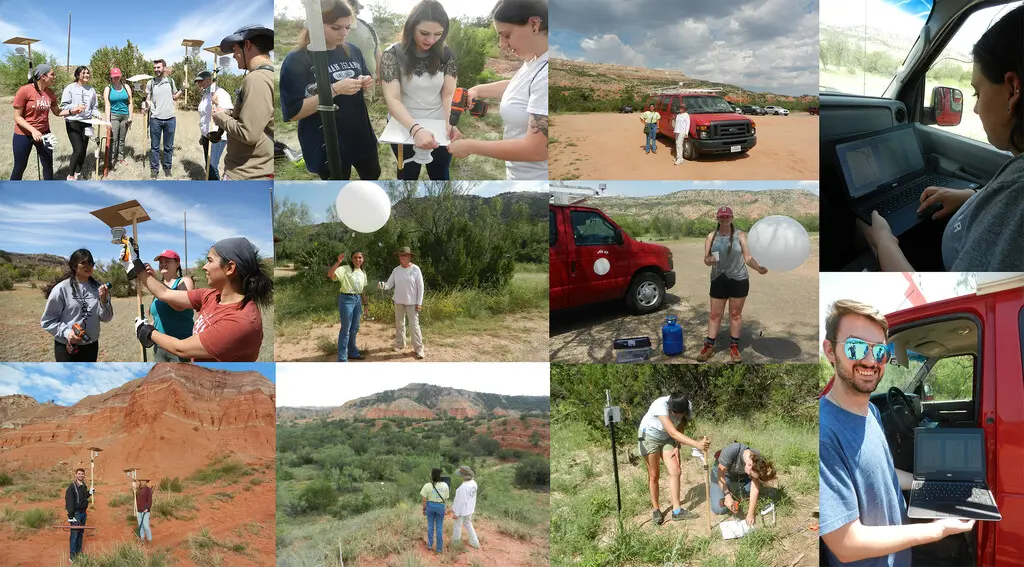
This paper highlights the value of engaging undergraduate students in authentic research and shows how those experiences shape career trajectories. The study reports findings from the SCORCHER (Summertime Canyon Observations and Research to Characterize Heat Extreme Regions) campaign, which was led by undergraduate researchers and made use of Windsond S1 radiosondes.
Instrument performance
The authors note that, “Despite their low cost, these sensors have been accurate, dependable, relatively easy to set up, and provide all of the data needed to achieve the overarching scientific goals,” when referring to our radiosondes and HOBO ground stations.
Why it matters
The paper demonstrates how affordable, field‑ready instrumentation can enable student‑led science at scale, producing publishable research while training the next generation of atmospheric scientists.
Invited perspectives: Thunderstorm intensification from mountains to plains
Appears in Natural Hazards and Earth System Sciences — a European Geosciences Union journal, in August 2025.
This invited perspective reviews the current state of research on thunderstorm development and makes the case for a coordinated European study, Thunderstorm Intensification from Mountains to Plains (TIM). It summarizes key scientific questions and recommends data‑collection strategies to advance understanding of storm initiation, growth, and intensification.
The paper highlights innovative observational platforms and specifically discusses Swarmsondes and Hailsondes, calling attention to their capabilities (see Figure 6) and their potential role in multi‑site field campaigns
Have questions or want a quote?
Fill in the form and we’ll get back to you with pricing, availability, and technical details.